Refractive Errors

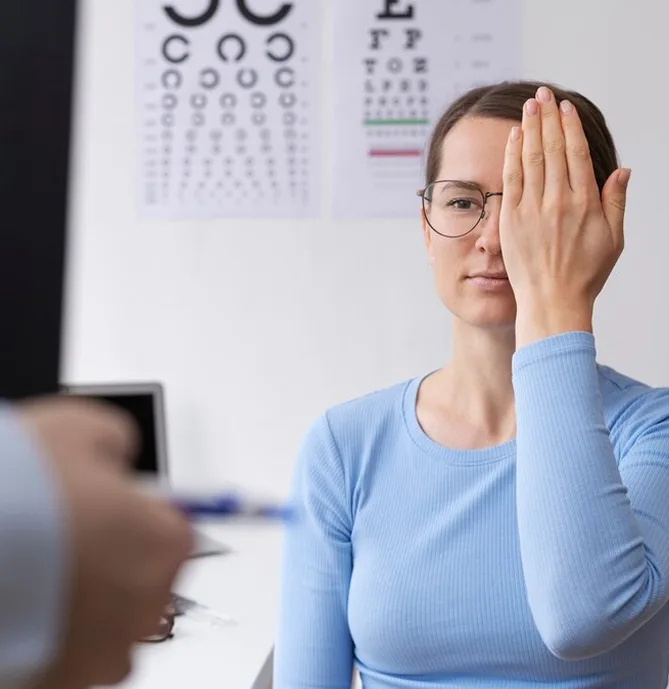
Refractive errors occur when the eye does not bend (refract) light correctly, preventing images from focusing sharply on the retina, the nerve layer at the back of the eye. This can make vision blurry.
An intraocular lens (IOL) is a clear, artificial lens surgically implanted inside the eye to replace a cloudy natural lens, such as in cataracts or certain refractive errors. The IOL focuses light onto the retina, much like glasses or contact lenses, and is chosen to meet each patient’s visual needs.
Types of Refractive Errors
Myopia (Nearsightedness)
Occurs when the eyeball is too long or the cornea is too curved, causing light to focus in front of the retina. People with myopia see close objects clearly, but distant objects appear blurred.
Signs and Symptoms
- Headaches
- Eyestrain
- Fatigue while driving or playing sports
- Squinting
Causes
- Often runs in families and usually appears in childhood
- May stabilize over time or worsen with age (“myopic creep”)
Treatment Options
- Non-surgical: Glasses, contact lenses
- Surgical: LASIK, LASEK, clear lens extraction, phakic IOL
Hyperopia (Farsightedness)
Occurs when the eyeball is too short, causing light to focus behind the retina. People with hyperopia may see distant objects well, but near objects appear blurred.
Signs and Symptoms
- Headaches
- Eyestrain
- Squinting
- Fatigue while driving or playing sports
Causes
- Most children are born hyperopic and may outgrow it as the eye grows
- Can be confused with astigmatism
Treatment Options
- Non-surgical: Glasses, contact lenses
- Surgical: LASIK, LASEK, clear lens extraction, phakic IOL
Astigmatism
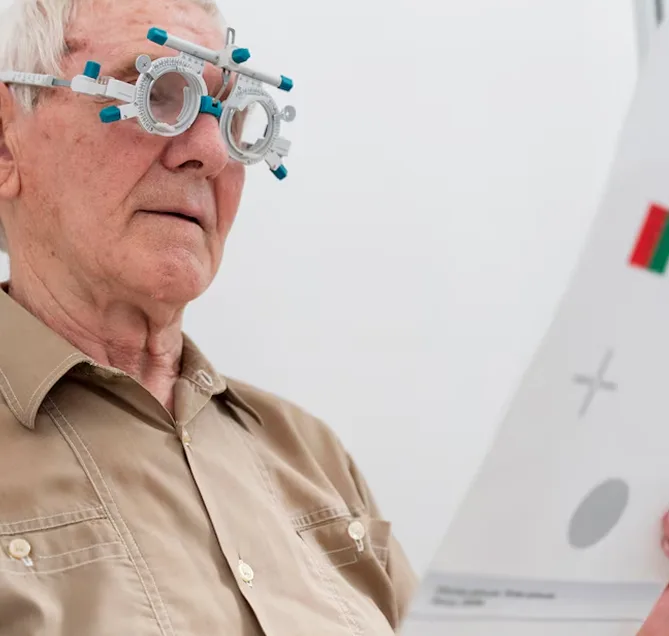
Occurs when the cornea is irregularly shaped, curving more along one axis than the other, causing light to focus at multiple points on the retina. Vision is blurred at near and far distances.
Signs and Symptoms
- Headaches
- Eyestrain
- Distorted or blurry vision
Treatment Options
- Non-surgical: Glasses or contact lenses
- Surgical: Excimer laser treatments for regular and mixed astigmatism; emerging therapies for irregular astigmatism
Presbyopia (Age-Related Near Vision Loss)
As people age, the lens inside the eye loses flexibility, making it difficult to focus on close objects. This usually begins around age 40.
Correction Options:
- Reading glasses or bifocals
- Monovision (one eye corrected for near vision, the other for distance)
Monovision
A method to correct presbyopia using refractive surgery. One eye is corrected for distance, the other for near vision. A trial with contact lenses may help determine if it suits the patient.
Why Choose Bascom Palmer Eye Institute?
Trusted Leaders
- Our multidisciplinary team lectures worldwide and conducts research to deliver outstanding results.
Patient-Centered Care
- We guide patients from initial exam to treatment and follow-up, making vision care easy and effective.
Comprehensive Services
- From routine eye exams to advanced surgical treatments, we provide complete care for patients of all ages.
FAQ
What are the main types of refractive errors, and how do they blur vision?
How do refractive errors develop over a lifetime?
What simple tests confirm refractive errors?
Beyond glasses, what correction options exist?
Can refractive errors be slowed or prevented?
Our Doctors
No doctors available for this speciality.

Questions? We’re here to help.
Our appointment specialists are ready to help you find what you need. Contact us today.